



Most people think low energy is a simple problem.
Maybe you need more sleep.
Maybe you need another cup of coffee.
Maybe you’re getting older.
Maybe life is just busy.

While those factors can certainly play a role, they often distract us from a much bigger question:
What if your body’s energy production system is working exactly as designed—but your nervous system is constantly telling your body that survival is more important than energy?
This is a conversation we have regularly with patients.
Many arrive frustrated because they have tried everything they can think of. They’ve improved their diet. They’ve started exercising. Some have tried supplements, energy drinks, or medications. Yet they still wake up tired, hit an afternoon wall, or feel like they are running on fumes by the end of the day.
The missing piece is often not found in another stimulant.
It’s found in understanding how the nervous system controls nearly every energy-related process in the body.
Your Body Is Always Making Decisions About Energy
Imagine your body operates like a business.
Every day it receives a limited budget of resources.
Those resources include:
- Calories
- Oxygen
- Nutrients
- Hormones
- Recovery capacity
- Mental focus

The nervous system acts as the chief executive officer.
Its primary responsibility is not happiness.
Its primary responsibility is survival.
Every second, your brain is asking:
- Am I safe?
- Am I under threat?
- Do I have enough resources?
- Should I invest in growth or prepare for danger?
The answer to those questions determines how your body allocates energy.
When your nervous system perceives safety, energy can be directed toward healing, digestion, recovery, hormone balance, learning, and performance.
When your nervous system perceives stress, energy gets redirected toward survival.
And survival is expensive.
Why Stress Is More Draining Than Most People Realize
Most people associate stress with emotional stress.
Deadlines.
Finances.
Relationships.
Work.
But your nervous system doesn’t distinguish between different types of stress the way you do.
To your nervous system, stress can come from many sources:
- Chronic pain
- Poor posture
- Sleep deprivation
- Inflammation
- Blood sugar swings
- Digestive dysfunction
- Repetitive injuries
- Emotional overwhelm
- Chronic infections
- Nutrient deficiencies

Imagine trying to drive your car with one foot on the gas pedal and one foot on the brake.
Eventually the engine starts working harder than it should.
That’s exactly what can happen when your nervous system spends too much time in a stress-driven state.
Your body isn’t broken.
It’s exhausted from constantly preparing for threats
The Hidden Cost of Living in “Fight or Flight”
Most people have heard of fight-or-flight.
What many don’t realize is that this response was designed for emergencies—not lifestyles.
Thousands of years ago, the stress response helped humans escape predators, survive danger, and respond to immediate threats.
Today, many people activate the same response dozens or even hundreds of times per day.
An email arrives.
Traffic gets backed up.
The kids are late.
A deadline approaches.
Pain flares up.
Sleep was poor.
The body responds.
Heart rate changes.
Stress hormones rise.
Blood flow shifts.
Muscles tighten.
Energy is redirected.

Over time, this can create a situation where your body becomes incredibly efficient at surviving while becoming increasingly inefficient at thriving.
Many people begin experiencing:
- Brain fog
- Afternoon crashes
- Difficulty concentrating
- Poor recovery
- Increased aches and pains
- Irritability
- Sleep challenges
- Low motivation

Ironically, they often push harder to compensate.
More caffeine.
More energy drinks.
More willpower.
Meanwhile the underlying nervous system imbalance remains unchanged.
Why Poor Energy Is Often a Brain Problem Before It’s a Muscle Problem
When people feel physically tired, they often assume their muscles are the issue.
In reality, fatigue frequently begins in the brain.
Your brain represents only a small percentage of your body weight, yet it consumes a tremendous amount of energy.
It constantly processes information from:
- Your eyes
- Your ears
- Your balance system
- Your joints
- Your muscles
- Your organs
- Your environment
Every second, the brain is filtering and organizing enormous amounts of information.
When the nervous system becomes overwhelmed, inefficient, or stressed, the brain may begin conserving resources.

Think of it like a smartphone.
When the battery gets low, the phone automatically enters low-power mode.
Certain functions slow down.
Background activity decreases.
Performance changes.
Your body often does something remarkably similar.
The result can feel like:
- Mental fatigue
- Slow thinking
- Difficulty focusing
- Reduced motivation
- Feeling “off”
- Needing excessive caffeine just to function
The problem isn’t necessarily that you’re lazy or unmotivated.
Your nervous system may simply be trying to conserve resources.
The Surprising Relationship Between Pain and Energy
Many people underestimate how exhausting pain can be.
Pain is not just a sensation.
Pain is a neurological event.

When pain signals are constantly being processed, your nervous system must devote energy to monitoring, managing, and responding to those signals.
Think about a smoke detector that keeps chirping.
Even if you eventually tune it out, your brain never completely ignores it.
Pain works similarly.
Whether it’s neck pain, headaches, low back pain, or chronic tension, the nervous system remains engaged.
This ongoing demand can contribute to:
- Mental fatigue
- Poor sleep
- Increased stress hormones
- Reduced recovery
- Lower resilience
For some people, improving energy begins with improving how the nervous system processes pain.
Why Digestion and Energy Are Closely Connected
Here’s something many people never consider.
Digestion is one of the most energy-intensive activities your body performs.
Your body must:
- Break down food
- Absorb nutrients
- Produce enzymes
- Manage blood sugar
- Eliminate waste

When the nervous system is stuck in a stress-dominant state, digestion often suffers.
This can create a vicious cycle.
Poor nervous system function affects digestion.
Poor digestion affects nutrient absorption.
Poor nutrient absorption reduces energy production.
Lower energy increases stress.
Stress further impacts nervous system function.
Many people spend years trying to solve fatigue with supplements while overlooking the system responsible for using those nutrients effectively.
The Energy Triangle: Brain, Body, and Chemistry
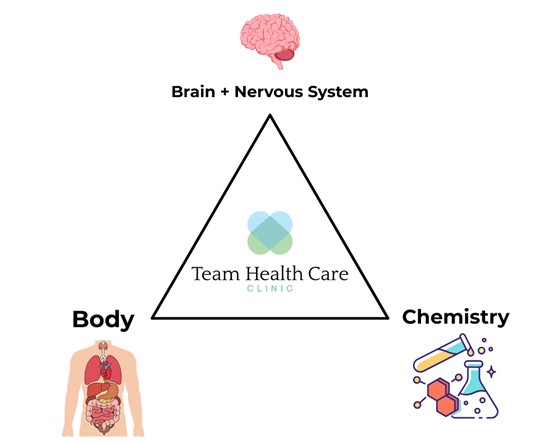
At Team Health Care Clinic, we often explain health through three interconnected systems:
Brain
The nervous system coordinates every major function in the body.
When communication is disrupted, energy regulation can suffer.
Body
Movement, posture, joint function, and physical stress all influence how efficiently the body operates.
Poor biomechanics create unnecessary demands on the nervous system.
Chemistry
Nutrition, hormones, inflammation, hydration, and gut health directly affect the body’s ability to create and sustain energy.
The challenge is that many people focus on only one side of the triangle.
They work on nutrition but ignore stress.
They exercise but neglect recovery.
They manage symptoms without addressing nervous system function.
Real energy often requires looking at all three.
What Most People Get Wrong About Fatigue
Perhaps the biggest mistake people make is assuming fatigue means they need more stimulation.
Energy and stimulation are not the same thing.
Coffee can create stimulation.
Energy drinks can create stimulation.
Sugar can create stimulation.

But stimulation is often borrowed energy.
It’s like taking an advance on tomorrow’s paycheck.
True energy comes from efficiency.
When your nervous system communicates effectively, your body spends less energy compensating and more energy performing.
The goal isn’t to force the body to do more.
The goal is to help the body function better.
Practical Ways to Support Your Nervous System
If you’re struggling with energy, start by asking better questions.
Instead of:
“How do I get more energy?”
Ask:
“What is draining my energy?”
Some helpful starting points include:
- Prioritizing sleep quality
- Managing blood sugar stability
- Moving regularly throughout the day
- Spending time outdoors
- Improving posture and ergonomics
- Addressing chronic pain
- Practicing stress management strategies
- Staying hydrated
- Evaluating nutritional deficiencies
- Assessing nervous system function
Small improvements across multiple systems often create bigger results than one dramatic intervention.
The Bottom Line
If you’ve been struggling with low energy, brain fog, poor sleep, or feeling like you’re running empty, it may be time to look beyond temporary fixes and take a closer look at how your body is functioning.
At Team Health Care Clinic, we help patients uncover hidden stressors that may be impacting their energy, including nervous system dysfunction, chronic stress, structural imbalances, inflammation, nutritional deficiencies, and other underlying factors that are often overlooked.
Our team takes a comprehensive approach by evaluating the Brain, Body, and Chemistry systems that influence how you feel every day. Rather than simply asking, “How do we increase your energy?” we ask, “What is draining your energy in the first place?”
If you’re tired of guessing and would like a clearer picture of what’s happening inside your body, we’d love to help.
Schedule a consultation with our team to learn whether nervous system stress, structural issues, or other underlying factors may be preventing you from feeling your best.
Because sometimes the solution isn’t more caffeine, more supplements, or more willpower.
Sometimes it’s discovering what your body has been trying to tell you all along.
